Although From Different Cultures These Works of Art Have What in Common?

Map showing world Sikh population areas and historical migration patterns (Est. 2004).[1]
The Sikh diaspora is the modern Sikh migration from the traditional expanse of the Punjab region of Republic of india. Sikhism is a organized religion, the Punjab region of India existence the historic homeland of Sikhism. The Sikh diaspora is largely a subset of the Punjabi diaspora.[2]
The starting signal of the diaspora is commonly accustomed to accept begun after the fall of the Sikh Empire in 1849 and the Empire's subsequent looting into the British India. The near famous personification of the Sikh diaspora was the outset, Maharajah Duleep Singh, the concluding Emperor of the Sikhs who was coerced into a lifetime exile past the British Raj. Since Duleep Singh's exile, the rate of Sikh migration from Punjab has remained loftier; however, the destination for Panjabi Sikh migrants has changed during the ensuing 150 years. The evolution of the Punjabi Sikh diaspora concept has given diaspora Sikhs a conscious political and cultural identity, which forms a reference point for their 'Sikhism'.
Organized religion [edit]
With more than 25 meg worldwide,[3] Sikhs are adherents to the fifth-largest faith in the world, Sikhism, making upwards 0.39% of the globe population.[four] [ failed verification ] The 2011 Indian census reported approximately xx one thousand thousand Sikhs living in India.[5] Of these, sixteen million, or 76% of all Indian Sikhs, live in the northern land of Punjab, where they form 58% of the population.[5] Substantial communities of Sikhs, more than 200,000, lived in the Indian states and union territories of Haryana, Rajasthan, Uttar Pradesh, Delhi, Himachal Pradesh, Maharashtra, Uttarakhand and Jammu and Kashmir as of 2011.[5] The Canadian province of British Columbia is also home to over 200,000 Sikhs.[6]
Historical migration patterns [edit]
The Sikhs every bit a political entity, distinct from other Indian traditions, tin can be said to have begun with the martyrdom of the 5th Sikh Guru, Guru Arjan Dev Ji in 1606, Sikh distinction was farther enhanced by the institution of the Sikh 'Pure' brotherhood or Khalsa (ਖ਼ਾਲਸਾ), by Guru Gobind Singh Ji in 1699.[7] This gives the Sikhs, as an organized political grouping, a relatively recent history of effectually 400 years. Migrations of Sikhs during the era of the Gurus were limited to the boundaries of modern-day India and Islamic republic of pakistan, and in detail, restricted to the Sikh tribal heartland of the Punjab Region.The evolution of the Sikh Confederacy and the development of the Sikh Empire (1716–1849), led to Sikhs migrating to conquered parts of their empire such equally Ladakh and Peshawar. Even so, these migrations were limited, transitory, and unsustained, depending on the Empire'southward fluctuating boundaries. During the time of the Sikh Empire, there was a cyberspace cultural immigration, with Napoleonic and British influences vying for the 'ear' of the and then Sikh Maharajah Ranjit Singh.[8] With respect to the Sikh diaspora, the most important political aspect of this period was the historical establishment of a Sikh homeland; the idea of a powerful Sikh state was a reality.
Looting of the Punjab [edit]
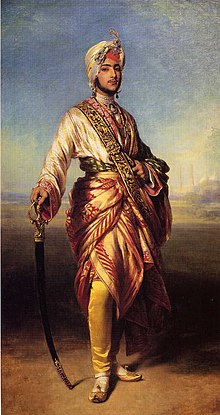
Maharajah Duleep Singh, the first and most famous member of the Sikh diaspora
Sikh migration from Punjab began in earnest in the second one-half of the 19th century when the British Raj had successfully completed its annexation of the Punjab. The pivotal activity in the British annexation was the lifetime exile of the then eleven-year-old Maharaja, Duleep Singh, thus making Singh the starting time (although unwilling) member of the Sikh diaspora.
Although a largely secular figure who did piddling for the Sikh body politic, Axel (2001)[9] argues that Duleep Singh's exile has had a major impact on the Sikh diaspora psyche. Axel(2001)[ten] says that Duleep Singh is the archetypal 'tragic hero' figure in Sikh culture, "a King without a Kingdom, a Sikh separated from his people"; the contrast between Duleep Singh and his strong ruler begetter, Maharaja Ranjit Singh Ji.
Having annexed the Sikh Kingdom, the British Raj preferentially recruited Sikhs in the Indian Civil Service and, in particular, the British Indian Army, which led to the migration of Sikhs to different parts of British India and the British Empire.[xi] Semiskilled artisans were transported from the Punjab to British East Africa to assist in the building of railways, while many Sikhs constitute themselves in Australia working as Ghans, or cameleers and every bit labourers on pikestaff plantations.
20th century [edit]
The Sikhs fabricated tremendous contributions to Punjab from 1857 to 1947. Sikhs founded the city of Rawalpindi. Sikh agricultural and entrepreneurial skills brought prosperity to Sheikhupura, Sialkot, Jhelum, Multan, Sargodha, Gujrat, Ludhiana, Amritsar, Jullundar. Lahore, the capital of undivided Punjab, had thriving Sikh neighborhoods.
The era of peace and prosperity turned into a nightmare in 1947. The partition of Punjab between India and Pakistan was a seminal tragedy for Sikhs. The Sikh communities were practically wiped out from Lahore, Rawalpindi, Multan, Sialkot, Lyallpur, Jhelum, Gujrat, Sargodha, Sheikhupura and other districts of Due west Punjab. The birthplace of Sikhism, Nankana Sahib, was dissever abroad in W Punjab. Millions of Sikhs fled to liberty and safety in Due east Punjab in India. Such intense violence in E Punjab had caused many villages and cities to become through reconstruction. Smaller numbers also fled to Afghanistan.[12]
In 1960s and across many Sikhs migrated to the Uk and N America in search of economical opportunities. Some of the Sikhs who had settled in eastern Africa were expelled by Ugandan leader Idi Amin in 1972.[thirteen] Sikhs are primarily an agrestal community and with the pressures of having only a express amount of state, high nascency rates and the desire to make a better living, the male offspring of Sikh farmers were encouraged to migrate to foreign countries. Subsequently, the main 'button' factor for Sikh migration has been economical with significant Sikh communities at present being found in Philippines, Canada, the Uk, the Usa, Malaysia, East Africa, Australia and Thailand.
Agitation for a homeland [edit]

Axel (2001)[9] argues that the Sikh diaspora community, having established themselves in foreign countries, begin to fetishize the past and nurture idealized designs for their 'lost and imaginary' Sikh empire. This comes into fruition to a certain degree with the establishment of Indian Punjab in 1966 equally a Sikh majority state. However, Tatla(1998)[14] argues that the marginalization and sense of grievance that Indian Sikhs were facing due to Indira Gandhi's heavy-handed tactics were amplified in the Sikh diaspora. Subsequently, the Sikh diaspora, especially in South Vancouver, Canada[15] and the UK become willing suppliers of logistical and financial support when the organic agitation for a separate Sikh nation, Khalistan, began in the late 1970s. The actions taken by the Indian authorities to counter the Sikh separatist movement, via 1984's Operation Blue Star, had a seismic issue on the Sikh diaspora. Axel (2001)[xvi] argues that the desecration of the Sikh'due south holiest shrine, Harimandir Sahib, and the post-obit Sikh pogrom in which thousands of Sikhs were massacred; led to a resurgence in Sikh religiosity and a strengthening of ties with their Sikh brethren in Punjab. Diaspora Sikhs felt betrayed by Bharat, and the events of 1984 divers their Sikhism and underlined a distinct commonality shared with other diaspora Sikhs. Mark Tully[17] describes 1984's Performance Blue Star equally the Sikh's 'nine/11', this was certainly the case for diaspora Sikhs, who in the main could only watch on in horror as the events of 1984 played out on TV.
In 1971 Dr Jagit Singh Chohan, an ex-minister in a short-lived government of Akali dissidents, saw an alignment of agreeing Sikhs. Chohan placed a half-page advert in The New York Times of 12 October 1971, making several claims near Punjab as a Sikh homeland. However, Chohan won little sympathy from ordinary Sikhs[18]

Sikhs in London protest against Indian government actions
Tatla summarises the change in Sikh diaspora community leaders mail 1984 a being a "painful transition from a self-confident community with haughty soapbox, to the self-defensive strategies of a vulnerable minority".[18] Organisations such as the International Sikh Youth Federation (ISYF), the Babbar Khalsa and the Quango of Khalistan emerged within the diaspora, and these agencies rallied confronting "Hindu imperialism" or "Indian nationalism" and lobbied to join the Unrepresented Nations and Peoples Organization UNPO aligning the Sikh cause with other ethnic groups seeking freedom, citing cases of Jews, Palestinians, Kurds, Balochis, Kashmiris and Sri Lankan Tamils. Another organisation past the proper noun of Sikhs for Justice, headquartered in New York, which surfaced roughly in 2014, has now self appointed it as the leader for the separatist movement, and is campaigning for the cause using activities like #BurnTheTricolour.[nineteen] [20] [21] [22] [23]
Axel (2001)[9] argues that the history of the Sikh diaspora, its psyche of grievance and the violence inflicted on it, means that the notion of the Sikh diaspora as a community today inevitably converges on the notion of Khalistan. In addition to this, Axel points out the 'nightmare' scenario facing the Sikh diaspora; the Indian state 'demands' the 'Unity-in-Diversity' model of 'rashtriya ekta' (national integration) which Axel contends is signified by "the denial of difference through surrender, assimilation and integration".
Since the formation of the Khalsa, the Sikhs take defined themselves though their 'separateness' and have differentiated themselves philosophically and physically from other Indian religious communities, thus the procedure of 'rashtriya ekta' is a threat to Sikhi itself. Any 'weakening' or 'dilution' Sikhi in the Punjab, is doubly painful for the Sikh diaspora for it ways a corresponding weakness in Khalistan, which, both real and imaginary, epitomizes the Sikh diasporic place today.
Sikh identity today [edit]
Whilst the rate of Sikh migration from the Punjab, India has remained high, traditional patterns of Sikh migration that favored English speaking countries, particularly the Britain, has changed in the past decade due to factors such as stricter immigration procedures. Moliner(2006)[24] states that equally a outcome of the 'fact' that Sikh migration to the UK had "go nigh impossible since the late 1970s", Sikh migration patterns contradistinct to continental Europe. Italy has now emerged every bit a fast-growing area for Sikh migration,[25] with Reggio Emilia and the Vicenza province being areas of significant Sikh population clusters.[26] The Italian Sikhs are generally involved in the areas of agriculture, agro-processing, machine tools and horticulture.[27] Canada has maintained a liberal immigration policy, and the Sikh community there is the 2d largest in proportion to the country's population after only Republic of india (ane.iv% of Canada's population versus ane.7% of India'due south). The largest Northward American Sikh community is thought to exist located in Due south Vancouver, British Columbia and nearby Surrey, British Columbia, while Brampton, Ontario besides has a big Sikh population.[ citation needed ] The Sikh migration to Australasia has also increased to a large extent in the first decade of the 21st century.
In the postal service-9/11 era, the Sikh diaspora in Europe and North America stand out every bit a visible minority oftentimes confused with radical Islamic groups because of their turbans. There have been numerous hate crimes targeted at Sikhs. France banned turban-wearing Sikh students from publicly funded schools as part of a broader policy originally intended to restrict Muslim head-scarves. Western security think-tanks quote the Air India bombing to justify profiling of Sikh travellers at airports. Countering this train of thought, on 16 January 2018, Gurbir Grewal became attorney general of New Jersey - the first practicing Sikh in the Us to become a Land Chaser General.[28] The soft influences of pop civilisation and the need for fitting in with peers are driving many young Sikhs to shed Khalsa symbols such as the turban and beard. Some second-generation Sikhs growing upward in the Due west exercise not have proficiency in the Punjabi language. On the other hand, small groups of Westerners have converted to Sikhism.[ citation needed ] There are at present Sikh Gurduwaras (equivalent of churches and temples) scattered across Europe, North America, Australia and Malaysia. The combination of these factors creates a new and more circuitous Sikh identity that may slowly emerge in the 21st century.
See also [edit]
- Sikhism past country
References [edit]
- ^ Johnson and Barrett(2004) used in map construction. Research Paper: Quantifying alternate futures of religion and religions by Todd K. Johnson and David B. Barrett (2004). Refer to Tabular array 1. Global adherents of the globe'due south 18 major distinct religions, AD 1900–2025. Published past Elsevier Ltd, Available online 15 July 2004 [1]
- ^ Encarta "Archived copy". Archived from the original on 2 October 2009. Retrieved 25 June 2009.
{{cite web}}: CS1 maint: archived copy equally championship (link) - ^ "Sikhism". Encyclopædia Britannica . Retrieved 7 August 2018.
- ^ CIA Factbook
- ^ a b c "Sikh Faith Census 2011". census2011. Retrieved 21 January 2018.
- ^ "NHS Profile, British Columbia, 2011". Statistics Canada. 8 May 2013. Retrieved 8 September 2019.
- ^ BBC History of Sikhiam - The Khalsa
- ^ Maharaja Ranjit Singh: Lord of the Five Rivers (French Sources of Indian History Series) by Jean-Marie Lafont. Pub. past Oxford Academy Press (2002). pp. 23–29. ISBN 0-19-566111-7
- ^ a b c A review of The Nation's Tortured Body: Violence, Representation, and the Formation of the Sikh "Diaspora" by Brian Keith Axel . Pub. by Duke University Press (2001).
- ^ A review of The Nation's Tortured Trunk: Violence, Representation, and the Formation of the Sikh "Diaspora" by Brian Keith Axel . Pub. past Duke Academy Press (2001). pp. 48–65
- ^ Improvidence of Sikhism and recent migration patterns of Sikhs in India by A. Yard. Dutt1 and South. Devgun. Pub. GeoJournal Volume i, Number 5 / September,1977.Pp 81-89. Available online [two] [ expressionless link ]
- ^ "Explainer: who are the Afghan Sikhs?". The Conversation. 20 August 2014.
- ^ Sikhism. Encyclopædia Britannica. 2007. Encyclopædia Britannica Online. 12 Sept. 2007 [3]
- ^ The Sikh Diaspora Search for Statehood by Darshan Singh Tatla(1998). pp. 16–33. Pub. past Academy of Washington Printing. ten-295-97715-9
- ^ The Sikh Diaspora in Vancouver: Iii Generations Amid Tradition, Modernity, and Multiculturalism past Kamala Elizabeth Nayar. Pub. by University of Toronto Printing (8 April 2004) Pp.34-57. ISBN 0-8020-8631-4
- ^ A review of The Nation's Tortured Body: Violence, Representation, and the Germination of the Sikh "Diaspora" by Brian Keith Axel . pp. 68–72. Pub. past Duke University Press (2001).
- ^ BBC Athenaeum: After Blue Star
- ^ a b Shackle, Christopher; Gurharpal Singh; Arvind-Pal Mandair (2001). Sikh Religion, Culture and Ethnicity. Richmond, Surrey: Curzon Printing. pp. 142–161. ISBN0-7007-1389-1.
- ^ Haider, Masood (8 June 2014). "Sikhs living abroad to concord 'plebiscite' for separate homeland". DAWN.COM . Retrieved 26 Apr 2019.
- ^ Singh, Yoshita (20 March 2014). "U.s.a. gauge reserves ruling on 1984 anti-Sikh riots". Mint . Retrieved 26 Apr 2019.
- ^ Contributor, Special (19 November 2013). "Sikh groups launch signature campaign in support of UN 'genocide petition'". The Hindu. ISSN 0971-751X. Retrieved 26 April 2019.
- ^ "Over 20,000 People Sign White House Petition for Jagtar Hawara'southward Release". NDTV.com . Retrieved 26 April 2019.
- ^ "UK takes cautious line on pro-Khalistan SFJ meet". The Tribune India. eleven July 2018.
- ^ Sikh Migration Patterns - 'Workshop on Indian Migration' at Laboratoire d'Anthropologie Urbaine/CNRS (14/15 November 2006) Abstract 'Sikhs in France' by Christine MOLINER (PhD Student, Ecole des Hautes Etudes en Sciences Sociales (EHESS)) "Archived copy". Archived from the original on 17 November 2006. Retrieved four April 2008.
{{cite web}}: CS1 maint: archived copy as championship (link) - ^ Sikh Storia e immigrazione - The Sikhs: History and Immigration past R. Cipriani(2006). Pub. in International Sociology.2006; 21: 474-476 Available on "Archived re-create". Archived from the original on 10 Apr 2008. Retrieved 4 April 2008.
{{cite web}}: CS1 maint: archived copy as title (link) - ^ At present, Sikhs practice a Canada in Italy
- ^ Written report of 'NRI' News in Italy
- ^ Due north.J. gets first Sikh chaser full general in U.S. history
Further reading [edit]
- The Sikh Diaspora Search for Statehood by Darshan Singh Tatla (1998) University of Washington Press. ISBN 0-295-97715-9
- Contesting Khalistan the Sikh diaspora and the politics of separatism /Gunawardena, Therese Suhashini. January 2001 Thesis (PhD). Pub. by University of Texas at Austin, 2001. Available at: http://repositories.lib.utexas.edu/handle/2152/6181
- Twice Versus Direct Migrants: East African Sikh Settlers in Britain by Parminder Bhachu. Pub. past Clark University (7 April 1990).
- Relational Embodiments of a Sikh Diaspora by Anjali Gera Roy Pub. by Indian Constitute of Technology, Kharagpur, India (2001). Available on https://web.archive.org/web/20070701185828/http://social.chass.ncsu.edu/jouvert/v7is1/gera.htm.
- Sikhs at Large: Organized religion, Civilization, and Politics in Global Perspective past Verne A. Dusenbery (2008) Oxford Academy Press. ISBN 978-0-19-568598-5; ISBN 0-19-568598-ix
- Sikh Diaspora Philanthropy in Punjab: Global Giving for Local Practiced by Verne A. Dusenbery and Darshan S. Tatla, eds. (2009) Oxford University Press. ISBN 978-0-nineteen-806102-1; ISBN 0-19-806102-1
- Sikhs in Latin America: Travels Among the Sikh Diaspora by Swarn Singh Kahlon (2012) Manohar Publishers and Distributors, New Delhi, India. ISBN 978-81-7304-938-5
External links [edit]
- Indian Diaspora, Official Government of Bharat Website
- Sikh NRI Online, Info pertaining to Sikh NRIs Worldwide
- History of Sikh Diaspora in Canada and Usa
- Sikh Global Village - Latin America
0 Response to "Although From Different Cultures These Works of Art Have What in Common?"
Post a Comment